In 1981, British ceramicist Tony Hepburn was one of the first artists invited to a summer workshop called “Artists in Industry” sponsored by The Ree Schonlau Gallery in Omaha, Nebraska. Hepburn, who was then teaching at Alfred University, accepted the invitation to this Alternative Worksite Program, which was held at the industrial site of Omaha Brickworks. The Artists in Industry initiative was founded by Ree Shonlau, now Ree Kaneko, and was aimed at promoting artists’ access to industrial worksites, such as the enormous kilns at Omaha Brickworks, where Jun Kaneko created his first monumental Dangos. Schonlau’s program would later evolve into the Bemis Center for Contemporary Arts, with Tony Hepburn, Ree Schonlau, Jun Kaneko, and Lorne Falk all co-founding the arts center. Today the Bemis Center continues to provide residencies and exhibitions to artists from around the world. From 1981 to 2024 over one thousand artists have been awarded residencies and support from the Bemis.
Hepburn cited “stacking wet bricks at the Omaha Brickworks” as one of the experiences that turned his sculptural interest to more vertical forms, causing him to begin his iconic “Gate” and “Totemic” series. Jun Kaneko and Tony Hepburn collaborated on several ceramic Gates over the years following their initial encounter in Omaha. The first, known as the Cranbrook Gate, was built by Hepburn in March of 1984 while he was a visiting artist at Cranbrook Academy of Art, where Jun Kaneko was head of the Ceramics department. Kaneko contributed additional pieces to the form and glazed it with his signature dotted surface pattern. This Cranbrook Gate was then temporarily installed on the Cranbrook campus in 1985.
Another Gate by Hepburn and Kaneko was built at Anderson Ranch Arts Center in June of 1984. Again, Kaneko made additions and alterations to Hepburn’s original form before it was bisque fired and shipped to Omaha. Kaneko and Hepburn then glazed this Gate together in 1986 at Jun Kaneko’s first Omaha studio. The artists created a painterly surface pattern for the Omaha Gate, full of colorful brushstrokes and splatters. The Omaha Gate and Cranbrook Gate are now part of the Ree & Jun Kaneko Foundation’s permanent collection. Lorne Falk, then curator of the Banff Centre School of Fine Arts in Alberta, Canada, noted the dynamic symbiosis resulting from these collaborations between Hepburn and Kaneko. Falk invited Hepburn and Kaneko, along with Canadian artist Faye Monroe, to collaborate in an unusual gallery exhibition entitled Convergent Territories: The Gallery as Artist’s Studio. The experimental exhibition converted the gallery space into a studio space, putting the artists’ studio on public view. While the artists worked, the gallery was open to the public, putting the artistic process on display for visitors. Each artist responded differently to their work spaces in the gallery, with Kaneko and Hepburn swapping spaces, allowing each other to respond to and alter one another’s work. Kaneko and Hepburn produced a number of drawings and sculptural pieces during this three-week period, several of which are also part of the Ree & Jun Kaneko Foundation’s permanent collection.

Untitled
1982
Oilstick on paper, 26 x 40 inches. Collection of the Ree & Jun Kaneko Foundation, Omaha, NE, USA.
Photo: Colin Conces

Untitled
1982
Oilstick on paper, 26 x 40 inches.
Photo: Colin Conces

Untitled
1982
Oilstick on paper, 26 x 40 inches. Collection of the Ree & Jun Kaneko Foundation, Omaha, NE, USA.
Photo: Colin Conces

Convergent Territories, The Gallery As Artist’s Studio, Tony Hepburn, Jun Kaneko, Faye Munroe
Oct 17 – Nov 7, 1982
The Walter Phillips Gallery, The Banff Centre School of Fine Arts, Banff, Alberta, Canada.
Photo: Ree Kaneko

Convergent Territories, The Gallery As Artist’s Studio, Tony Hepburn, Jun Kaneko, Faye Munroe
Oct 17 – Nov 7, 1982
The Walter Phillips Gallery, The Banff Centre School of Fine Arts, Banff, Alberta, Canada.
Photo: Ree Kaneko

Convergent Territories, The Gallery As Artist’s Studio, Tony Hepburn, Jun Kaneko, Faye Munroe
Oct 17 – Nov 7, 1982
The Walter Phillips Gallery, The Banff Centre School of Fine Arts, Banff, Alberta, Canada.
Photo: Ree Kaneko

Convergent Territories, The Gallery As Artist’s Studio, Tony Hepburn, Jun Kaneko, Faye Munroe
Oct 17 – Nov 7, 1982
The Walter Phillips Gallery, The Banff Centre School of Fine Arts, Banff, Alberta, Canada.
Photo: Ree Kaneko

Convergent Territories, The Gallery As Artist’s Studio, Tony Hepburn, Jun Kaneko, Faye Munroe
Oct 17 – Nov 7, 1982
The Walter Phillips Gallery, The Banff Centre School of Fine Arts, Banff, Alberta, Canada.
Photo: Ree Kaneko

Convergent Territories, The Gallery As Artist’s Studio, Tony Hepburn, Jun Kaneko, Faye Munroe
Oct 17 – Nov 7, 1982
The Walter Phillips Gallery, The Banff Centre School of Fine Arts, Banff, Alberta, Canada.
Photo: Ree Kaneko

Convergent Territories, The Gallery As Artist’s Studio, Tony Hepburn, Jun Kaneko, Faye Munroe
Oct 17 – Nov 7, 1982
The Walter Phillips Gallery, The Banff Centre School of Fine Arts, Banff, Alberta, Canada.
Photo: Ree Kaneko

Tony Hepburn building the Cranbrook Gate at Cranbrook Academy of Art.
1985
Bloomfield Hills, MI, USA,
Photo: Ree Kaneko

Kaneko's alterations to the unfinished piece, with Hepburn's drawing visible in the background.
1985
Cranbrook Academy, Bloomfield Hills, MI, USA,
Photo: Ree Kaneko
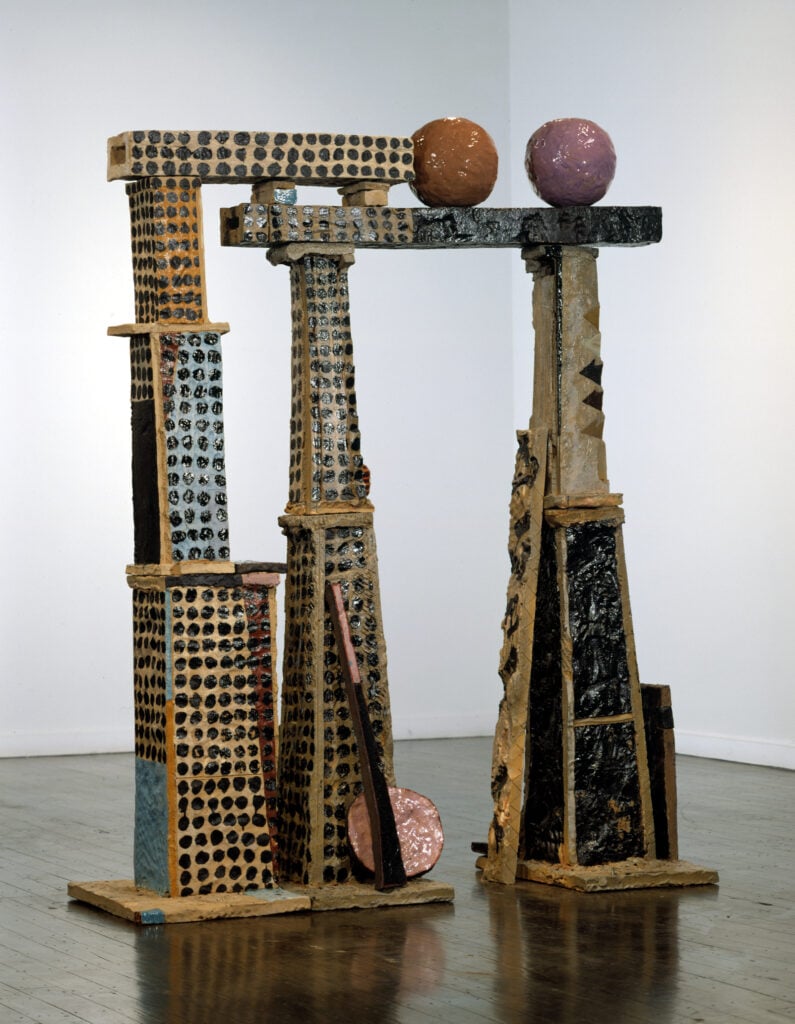
Cranbrook Gate
1985
Hand built and glazed ceramics, 77.5 x 77 x 62 inches. Collection of the Ree & Jun Kaneko Foundation, Omaha, NE, USA.
Photo: Ree Kaneko

Tony Hepburn at Anderson Ranch
1984
Snowmass Village, CO, USA
Photo: Ree Kaneko

Jun Kaneko at Anderson Ranch
1984
Snowmass Village, CO, USA
Photo: Ree Kaneko

Jun Kaneko and Tony Hepburn working on Omaha Gate at Kaneko's Omaha studio
1986
Omaha, NE, USA
Photo: Ree Kaneko

Jun Kaneko and Tony Hepburn working on Omaha Gate at Kaneko's Omaha studio.
1986
Omaha, NE, USA
Photo: Ree Kaneko

Omaha Gate
1986
Hand built and glazed ceramics, 84 x 67.75 x 21.75 inches. Collection of the Ree & Jun Kaneko Foundation, Omaha, NE, USA.
Photo: Ree Kaneko